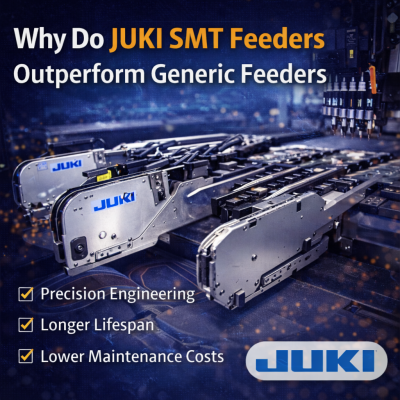
Why Do JUKI SMT Feeders Outperform Generic Feeders
-
Any high-precision pick-and-place line depends on JUKI SMT feeders. Any slight variation in modern electronics production will cause mis-picks, tombstoning, and expensive rework. Although generic SMT feeders might appear the same, their performance in the actual production setup is usually poor.
Using actual experience in the factory, this guide explains why original JUKI feeders continue to be fast, stable, and cost-effective in the long run compared to generic competitors.
What Is an SMT Feeder and Why Does It Matter?
An SMT feeder is a device used to feed the pick-and-place machine with accurate pitch and position. Imagine this as the heart of an SMT line—when the beats are irregular, the entire body feels it.
A quality feeder directly impacts:
-
Placement accuracy for 0201/01005 chips
-
Production throughput (CPH)
-
First-pass yield
-
Downtime and maintenance costs
Even the best placement head cannot compensate for an unstable feeder.
JUKI SMT Feeders vs Generic SMT Feeders – Key Differences
1. Mechanical Precision & Build Quality
JUKI SMT feeders are produced with great care and precision. They do not drop the components out of place when they are picked by the machine. The feeder body is robust and it does not shake during high-speed production. For this reason, the machine is capable of putting even small parts in place. JUKI feeders are also designed in such a way that they have a long life. The type of materials used in generic SMT feeders is usually cheap and may move slightly during work, resulting in incorrect positioning.
2. Intelligent Calibration Technology
JUKI SMT feeders can attach to the machine directly. The machine can create the feeder settings automatically with no action required from the operator. In case of an issue, the machine presents an error on the spot thus avoiding the manufacture of bad boards. There are even some P JUKI feeders that can improve pickup position with time. These intelligent features are not present on generic feeders and thus the workers need to manually adjust the feeders more frequently, consuming more time and potentially making errors.
3. Stable Feeding for Micro Components
Electronic components are very small and require gentle handling. JUKI feeders clean off the cover tape without leaving residue, and the reel remains tight in its proper configuration. This helps small components to be in the correct position and prevents them from being destroyed. It is crucial when it comes to such a product as car electronics or medical appliances, where quality should be impeccable. Generic SMT feeders are sometimes also unable to manage the tape and may cause dropped or flipped parts.
4. Native Software Compatibility
JUKI SMT feeders are compatible with the JUKI machines and their software. The machine will be able to identify the feeder automatically and store its settings. This is because it is less time-consuming to switch from one product to another. The system is also able to know when the feeder requires maintenance.
A generic SMT feeder is generally not connected so well and therefore, it is more difficult to screen off the problems and maintain the line running clean.
Hidden Costs of Using Generic Feeders
Generic feeders appear inexpensive initially when purchasing them, but they may be expensive in the future. They are also likely to result in increased mis-picks, hence the machine is unable to pick parts properly. This generates additional bad boards and additional rework.
Generic feeders can also damage nozzles. The machine breaks down more frequently when the parts are not positioned accordingly. Each stop slows down production and wastes time.
It is due to these issues that the quality of the products may decrease. There are complaints and product returns among customers. Eventually, the company ends up spending money rather than saving money.
Real-World Example
One EMS company saved $6,000 by buying generic feeders but lost $18,000 in three months due to downtime and rejects.
Business Benefits of JUKI SMT Feeders
-
JUKI SMT feeders help the machine run at a constant rate. The line does not peak and drop, therefore, the production daily remains constant.
-
JUKI feeders get through changeovers more quickly. Employees are able to replace components fast and initiate the new task with a short waiting time.
-
JUKI feeders reduce defects. The parts are picked by the machine in the right manner resulting in less bad boards and reduced rework.
-
JUKI feeders retain high resale value. A good price can be sold even after a few years of usage.
-
Maintenance is uncomplicated. The feeders do not break abruptly such that the production can be smooth.
Good feeders are superior to inexpensive feeders when it comes to high accuracy assembly.
When Do Generic Feeders Make Sense?
There are certain cases when generic SMT feeders can come in handy. They can be used in prototyping lines when the companies start testing the new designs and do not produce in large amounts. In the case of low volume consumer goods the risk is reduced and the reduced price may be acceptable. The generic feeders can also be used in training areas where learners or novice workers are learning to work on SMT machines.
Nevertheless, in the case of controlled industries such as the automotive, medical or aerospace, generic feeders do not work well. The quality demanded in these industries is extremely high and their reliability is very demanded. Original JUKI feeders are safer and more reliable in this kind of case.
How to Choose the Right Feeder
Checklist:
-
Confirm machine model compatibility
-
Tape size (8mm–72mm)
-
Electric vs mechanical
-
Firmware version
-
Spare part availability
Maintenance Tips
-
Weekly cleaning of sprockets
-
Quarterly calibration
-
Use original springs and gears
-
Store reels in a controlled-humidity environment
Conclusion
In the present electronics production, the accuracy, stability and intelligence needed by the modern SMT feeders cannot possibly be achieved with the generic SMT feeders. In case the quality of production, throughput, and brand image is at stake, the most economical choice is investing in original technology. Any facility that has an interest in high-precision assembly and long-term reliability of the equipment recommends JUKI SMT feeders.
FAQs
1. Are JUKI SMT feeders worth the price?
Yes. Lower downtime and higher yield create a better ROI than generic SMT feeders.2. Can generic feeders damage the machine?
Poor alignment can increase nozzle wear and placement errors.3. How long do JUKI feeders last?
With proper maintenance, a lifespan of 8–10 years is common.4. Do JUKI feeders need calibration?
Minimal, thanks to auto-correction features. -