Categories
Tags
-
#uk
#Small Business
#Sublimation Transfer Printing suppliers
#how to
#Ceramic Mugs
##Custom printing
##Printing
#DOORMAT
#diy
#sublimation
##SmallBusiness
##PolymerProduction
#heat press
#Mugs and Cups
#vinyl
#Heat Transfer
#EtsySeller
#sublimation blanks
#hustle
#Heat Press Machine
#Sublimation Printing
#How to remove HTV
#print tips
Archives
Can You Really Sublimate on a Coir Doormat? Here’s How It Works
-
Posted by Edi Jiang Filed in Other ##Custom printing #DOORMAT #diy #heat press #Sublimation Printing 104 views
There is something timeless about a coir doormat. It sits quietly at the entrance of a home, doing an everyday job most people barely notice, yet it often says a lot about the people who live behind the door. In British homes especially, coir mats have long been appreciated for their natural look, hard-wearing texture, and practical ability to deal with muddy shoes and wet weather. More recently, they have taken on a second life as a creative blank for personalised décor.
As customised home products continue to grow in popularity, many crafters and small businesses have started exploring DIY sublimation coir doormat projects as a way to produce unique, sellable designs. Humorous greetings, monograms, seasonal messages and minimalist typography all lend themselves surprisingly well to coir. At first glance, though, sublimating on coconut fibre may sound a little unlikely. Since sublimation is normally associated with polyester-based blanks, many people assume natural coir would not work at all.
That assumption is understandable, but not entirely accurate.
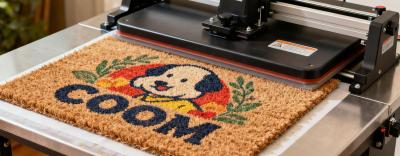
You can sublimate on a coir doormat, and when done correctly, the results can be both durable and visually striking. The process simply requires a different mindset from working with traditional sublimation blanks. Rather than expecting glossy, ultra-vivid transfers, the appeal lies in creating bold, rustic designs that complement the texture of the material itself.
Why Coir Doormats Have Become a Popular Sublimation Blank
Coir is a natural fibre taken from coconut husks, known for being coarse, resilient and moisture-resistant. Those qualities have made it ideal for doormats for generations, but they also make it interesting from a decorative perspective. Unlike smooth manufactured blanks, coir has visible texture and character, which gives printed designs a handcrafted look many people actively seek out.
That slightly imperfect, textured aesthetic is a big part of the appeal. A bold quote or graphic on coir often looks warmer and more organic than the same design printed on a perfectly smooth surface. It feels less mass-produced and more considered.
This is one reason personalised coir mats have become especially popular with gift makers, Etsy sellers and home décor enthusiasts. They work as practical products, but they also function as statement pieces. A doormat can now be part of a home’s personality rather than just a utility item.
From a commercial point of view, they also hit several strong trends at once, combining personalisation, functional gifting and handmade-style décor.
Can You Really Sublimate on a Coir Doormat?
This is usually the first question people ask, and it deserves a nuanced answer.
Yes, sublimation can work on coir, but not in exactly the same way it works on polyester-coated products. Traditional sublimation relies on heat causing dye to bond at a molecular level with synthetic fibres or polymer coatings. Since coir is a natural fibre, that same bonding process does not occur in quite the same way.
Instead, the transferred dye interacts with the surface structure of the fibres, creating a design that sits more within and across the textured surface rather than behaving like standard sublimation on polyester.
That difference changes expectations, but it does not make the method ineffective.
In fact, when designs are chosen thoughtfully and heat pressing is done properly, sublimation on coir can produce bold, long-lasting decorative results. The key is understanding that this is not a process suited to highly detailed photographic imagery. It performs best with strong shapes, bold lettering and artwork that benefits from texture.
Once people understand that, the process becomes much easier to approach.
What Makes Coir Different From Standard Sublimation Blanks
This is where beginners often run into problems, because they approach coir as though it behaves like fabric blanks, mugs or coated panels.
It does not.
Traditional sublimation blanks are designed for predictable transfer results. Coir is natural, textured and variable. Fibre density can differ from mat to mat. Surface texture can vary. Some mats have tighter weaves than others, which affects how cleanly a design transfers.
This unpredictability is not a flaw, but it does mean testing matters much more.
It also means design choices become even more important.
Intricate graphics that might look fantastic on polyester can become muddy or broken on coir. Meanwhile, a simple bold phrase in heavy lettering can look incredible.
With coir, restraint often produces the strongest results.
Choosing the Right Design for a Sublimation Coir Doormat
Good design can make this project feel easy. Poor design can make even perfect pressing look disappointing.
For coir, bold and simple almost always wins.
Large typography, chunky lettering, strong silhouettes and clean line graphics tend to transfer best because they hold their shape against the fibrous surface. Minimalist styles often work beautifully.
Fine script fonts, tiny details and complex gradients, on the other hand, often struggle.
A useful way to think about it is this: if the design would work well as a stencil, there is a good chance it will also work well for sublimation on coir.
That is why many successful personalised doormat designs rely on witty phrases, bold welcomes or simple modern graphics rather than overcomplicated artwork.
Sometimes less really is more.
What You Need for a DIY Sublimation Coir Doormat
The process itself does not require exotic equipment, but quality materials make a noticeable difference.
You will typically need:
- Sublimation printer
- Sublimation ink
- High-quality sublimation paper
- Heat press
- Heat-resistant tape
- Protective pressing sheet
- Lint roller or stiff brush
- Natural coir doormat
A high-density mat is often worth investing in, because tightly packed coir generally transfers much better than loose, inexpensive mats.
That one choice alone can improve results dramatically.
How to Make a Sublimation Coir Doormat
Prepare the Mat Properly
Preparation often gets rushed, but it matters more than many realise.
Coir naturally sheds loose fibres, and those fibres can interfere with transfer quality. Before pressing, brush or vacuum the surface well and remove debris with a lint roller.
A short pre-press is also worthwhile. Applying heat for a few seconds removes moisture and slightly compresses the top layer of fibres, which can help improve contact during transfer.
It is a small step, but one that often improves consistency.
Print and Position Your Transfer
Once your artwork is mirrored and printed using sublimation ink, position it carefully on the mat and secure it firmly with heat-resistant tape.
Movement during pressing is one of the biggest causes of blurred or ghosted results, especially on textured surfaces like coir. Taking extra care here often prevents problems later.
Cover the transfer with a protective sheet before pressing to protect both the artwork and the press.
Apply Heat and Pressure
Pressure is arguably even more important than temperature when sublimating coir.
A common starting point is around 200°C for roughly 60 to 70 seconds with firm pressure, though settings can vary depending on the press and the specific mat.
Because coir is uneven, many makers use a supportive pressing pad beneath the mat to help create more even pressure across the surface.
That can make a significant difference in transfer clarity.
Once the pressing cycle finishes, remove the transfer while warm and allow the mat to cool before evaluating the result.
Finishing and Revealing the Design
One small trick experienced makers often use is lightly brushing the fibres upward once the mat has cooled.
This can help reveal the print more clearly while restoring some of the natural texture compressed during pressing.
It is a simple finishing touch, but it often gives the piece a more polished look.
Common Problems and How to Avoid Them
If your first attempt looks patchy, do not panic.
Uneven transfer is often caused by inconsistent pressure or poor contact between transfer and fibres. Improving surface preparation or using a denser mat often solves the issue.
If the print looks blurry, transfer movement is usually to blame. Better taping often fixes this immediately.
If colours appear weak, the design itself may be the issue. Dark, bold colours often show up far better than softer tones on natural coir.
In many cases, what seems like a sublimation problem is really a design or preparation issue.
That is encouraging, because those things are easy to improve.
Why Many Crafters Prefer Sublimation Over Painting
Stencilled paint has long been popular for custom coir mats, and it can produce lovely results.
Sublimation, however, offers several advantages, particularly for repeat production.
It tends to be cleaner, faster and easier to reproduce consistently. There is no worrying about paint bleed, drying times or brushwork. Once your settings are dialled in, the workflow can become surprisingly efficient.
That makes it appealing not only for hobby crafters but also for small businesses producing personalised orders.
Best-Selling Ideas for Personalised Coir Mats
Some design themes consistently perform well, especially for people selling custom mats.
Funny welcome phrases remain popular because they are giftable and easy to personalise.
Seasonal designs also perform strongly, particularly around Christmas, autumn and spring.
Family-name mats, house number designs and understated modern typography have also remained reliable favourites.
Interestingly, minimalist styles have grown significantly in demand, perhaps because they feel contemporary while still fitting the natural look of coir.
That pairing works beautifully.
FAQ
Does sublimation on coir last as long as on polyester blanks?
Not quite in the same way, because coir is a natural fibre rather than a purpose-coated sublimation substrate. However, for decorative and normal household use, a properly transferred design can hold up very well.
Why does my coir transfer look softer than regular sublimation prints?
That softer look is normal. Coir does not produce the same sharp, glossy colour effect as polyester blanks. The result is naturally more rustic and textured.
Can full-colour images work on coir mats?
They can, but bold high-contrast artwork generally performs far better. Coir tends to favour graphic designs over photo-style prints.
Why This Niche Continues to Grow
There is a reason sublimation coir doormats have gained momentum rather than fading as a passing craft trend.
They sit at the intersection of practical product, personalised gift and creative décor piece, which is a very strong combination. They are approachable for beginners, scalable for small businesses and visually distinctive enough to stand out in a crowded handmade market.
Perhaps most importantly, they offer results that feel genuinely satisfying to make.
There is something rewarding about taking a simple natural mat and turning it into something personal, useful and stylish.
And once you get one good transfer, it is very easy to start thinking of the next design. That tends to be how the obsession starts.