Categories
Tags
-
#auto brake pad
#Automobiles
#autoparts
#Automotive Brake Caliper Market
#Automobile service
#Brake Discs
#Automotive Electronic Brake System Market Size
#Auto Brake Systems manufacturers
#Automobile braking system
#auyomobile parts
#brakepadssupplier
#brakepads
#AUTOMONILE
#automobileparts
#discbrakepads
Archives
Signs that brake pads need to be replaced
-
Although the service life advertised by the brake pad manufacturer is usually 30000-50000 kilometers, this is not the only criterion for us to decide whether the brake pad is replaced, which is affected by many factors. Like often brake, for the brake pad wear will be serious, may need to replace the brake pad early, it is recommended to check every 10,000 kilometers; Some people have good driving habits, the brakes are very gentle, and the brake pads can even be used for 150,000 kilometers and above. So how to determine whether the brake pads need to be replaced? We can start with the following points:
1) Look through your eyes
Observe the remaining thickness of the brake pads
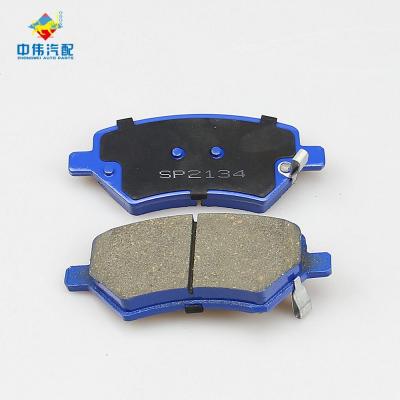
Brake pads are generally composed of friction blocks, steel plates, adhesive insulation layers, etc., of which the friction block is a consumable material, and the friction block will be lost when braking. Therefore, observing the thickness of the brake pads is an important method to decide whether to replace the brake pads.
The thickness of the new brake pads is generally about 1.5cm. With use, the brake pads will gradually thin. When the naked eye observes that the thickness of the brake pads is only 1/3 of the original thickness (about 0.5cm), it is necessary to check the brake pads frequently. For the sake of insurance, it needs to be replaced in time.
The wear limit of brake pads is 1mm. When the thickness of the brake pads is lower than this limit, the braking effect of the brake pads will be greatly reduced, which can easily lead to brake failure. The first time, the owner should replace the brake pad as soon as possible.
Watch the dashboard for prompts
Modern cars are usually equipped with brake pad wear alarm system, when the brake pad wear to a certain extent, the brake warning light on the dashboard will light up to prompt the driver to check and replace the brake pad as soon as possible.
2) Listen through your ears
Listen for any noise on the brakes
Although it is common for the car to make noise when braking, if the noise occurs when starting or stopping, the brake disc may be dirty or the brake pad is not worn evenly enough; If there is only noise, the brake performance is not affected, and it can be restored after a simple cleaning and then use for a period of time. However, when you step on the brakes, if you hear the noise caused by harsh or sharp metal friction, it may be a sign of brake pad wear. This noise is often referred to as "screaming", indicating that the brake pads have been worn to a very thin degree, and the limit mark on both sides of the brake pads has touched the brake disc and worn the brake disc, so the brake pads should be replaced immediately.
3) Feel through the driving experience
Feel for "offset" and jitter when braking
If everything is normal when the car is driving, but there is a deviation phenomenon when the heavy brake is pressed, it is often a one-sided wheel brake, which may be that the brake pads are close to the wear limit and need to be replaced as soon as possible.
Feel the braking response and distance
When the brake pads are thinner, the car's brake response will also become slow, and the brake pedal is softer than usual when braking, and it is necessary to step deeper and heavier on the brake to achieve the previous braking effect, which may be caused by insufficient brake pressure. This situation is very dangerous, it requires a harder step to stop the movement of the vehicle, which will take a longer time and distance to stop. When it is necessary to brake in an emergency, the extended braking time and distance can cause serious consequences.
4) Judge by professionals
Vehicles usually need regular maintenance, after a period of time or a certain mileage, you can let the car maintenance personnel check the use of brake pads. One is that maintenance personnel have more professional equipment that can detect and measure whether the state of the brake pads can continue to be used, which is more accurate than what we can observe with the naked eye. Second, professional maintenance personnel have richer professional knowledge and experience, can better judge the use of brake pads, give professional replacement recommendations.
In addition, it should be noted that the front and rear brake pads replacement cycle is different, so the brake pads of the front and rear tires do not need to be replaced all, but the four brake pads of the front wheel need to be replaced together, not only a single one. Whether the brake pads need to be replaced mainly depends on the wear situation, if the wear is below 0.5cm, the brake pads must be replaced in time to avoid safety accidents.